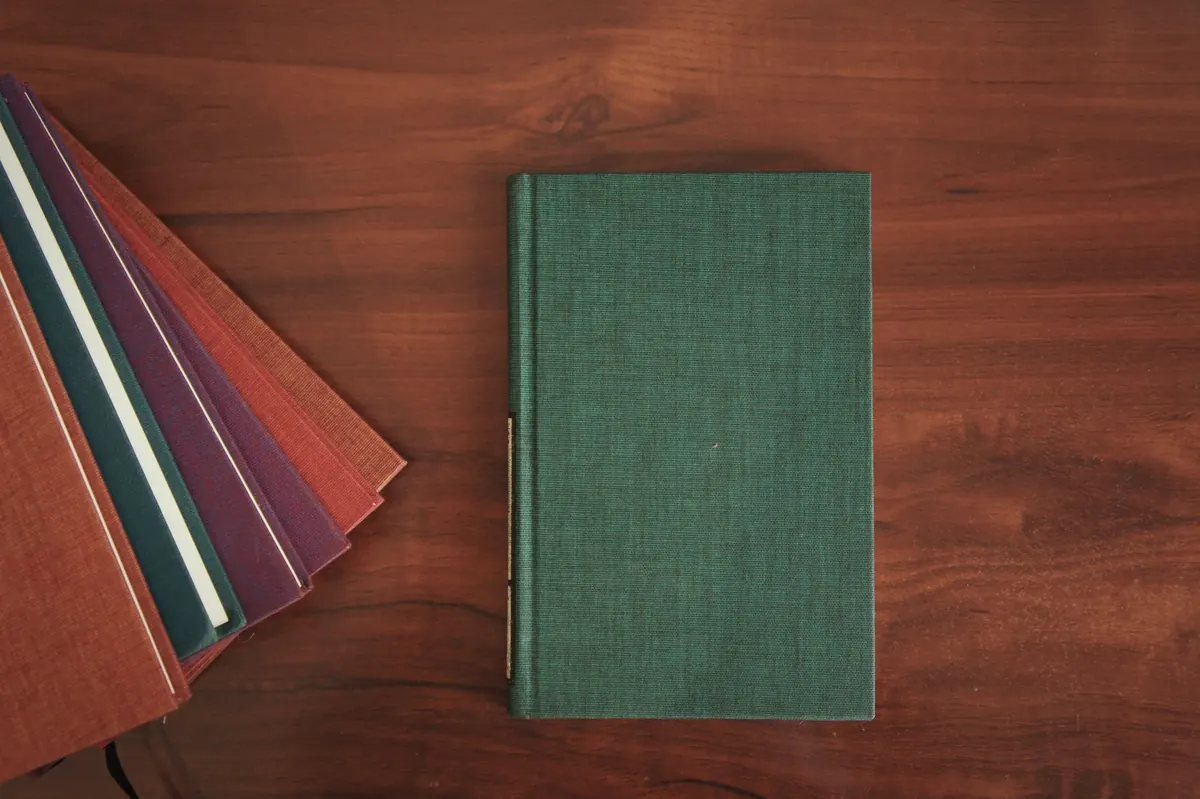
Pick up two A5 notebooks on the same shelf — one with a rigid board cover, one with card that bends in your hand — and the difference is obvious before you open either of them. That stiffness, or lack of it, decides where you can comfortably write, how the book looks after a year of use, and whether the pages stay flat when you want them to. Hardcover and softcover are not really competitors. They are two answers to different questions about how a journal gets used.
A hardcover journal is built around two boards, usually greyboard a couple of millimetres thick, wrapped in paper, cloth or a coated material. The page block is joined to those boards through the endpapers and a flexible hinge. Good hardcovers are sewn in signatures — small folded groups of pages stitched together — which is why they open flat without cracking. You will often find headbands at the top and bottom of the spine, a ribbon marker, and sometimes an elastic closure.
A softcover is simpler. The cover is a single sheet of card, often somewhere between 250 and 400 gsm, sometimes laminated and sometimes left with a soft-touch or uncoated finish. Pages are held in either by perfect binding — a glued spine — or by sewing. That distinction matters more than anything else about a softcover. A sewn softcover lies reasonably flat and keeps its pages for years. A glued one resists being opened wide, and if you force it, pages start to loosen at the back.
Hardcovers win on protection, and the corners tell the story. Board takes the knocks so the page block does not. Drop a hardcover on a tiled floor and you may dent a corner; drop a softcover and the corner folds, stays folded, and the pages behind it crease too.
The weak point of a hardcover is the hinge where the cover meets the spine. Force it open past its natural limit and the joint can crack, leaving the cover floppy in your hand. Treated well, though, a hardcover will comfortably outlast several softcovers of the same size.
Softcovers fail gradually rather than dramatically. Edges curl, spines crease from repeated opening, and the card picks up scuffs and a faint sheen from handling. None of that stops you writing, and some people like the worn look. But a softcover carried loose in a rucksack beside keys and a water bottle will look tired within a few months.
A hardcover A5 is noticeably heavier and chunkier than a softcover with the same page count, and you feel that difference by the end of a day of carrying it. A softcover A5 slips into a coat pocket; an A6 softcover disappears into a back pocket. If you write on trains, in waiting rooms or on a bench, that matters more than anything else in this comparison.
Hardcovers do travel better when they are travelling inside something else. A softcover in a bag gets bent against a laptop or a paperback; a hardcover holds its shape. So the question is not only which is lighter, but whether the book has a home of its own.
This is hardcover territory. A sewn hardcover opens flat, both pages sit level, and your hand rests on a stable surface instead of hovering over a slope. In a glued softcover the pages curve up towards the gutter — the inner margin near the spine — and the last centimetre of each page becomes awkward to write on. If you fill long entries, that is the first thing you will notice and the last thing you will forgive.
Softcovers have the advantage here. A slim softcover can be held and written in with one hand supporting it, which is far harder with a rigid board. Resist folding it back on itself to get a flat surface, though; that is the quickest way to break a glued spine. If you write standing up, a limp cover beats a stiff one every time.
Small softcovers win again. An A6 will sit in a palm; an A5 hardcover really wants a table or a lap. But note the trade-off: when you are balancing a book on your knee, a hardcover's rigid back is genuinely useful, because it gives you a writing surface that does not bend under the pen.
If most of your writing happens at a table with the book open in front of you, buy hardcover. If most of it happens wherever you happen to be, buy softcover — sewn if you can find it at a size you like. If you are split, keep both: an A5 hardcover as the main journal on the shelf, and a slim A6 softcover for your pocket.
Whichever way you go, a little care pays off. Break a hardcover in slowly: open to the middle, press a few pages down on each side, and work outwards in small groups rather than cracking it flat on day one. Keep a softcover in a slipcase and resist folding it back on itself. A journal you look after is one you can still read in ten years.
Photo: Telstarboy / Pexels
A practical, printable checklist for a journalling weekend away, covering notebooks, pens, ink, washi tape and the...

Grain direction decides whether paper folds cleanly or cracks, tears straight or ragged, and whether a bound book...
A practical five-step method for building consistent ink swatch cards that record true colour, drying time, water...

A journal for paper, ink, and craft.
